



Seated Liberty dollar (1840–1873) melt value
Every Seated Liberty silver dollar (1840–1873) is 90% silver. Each weighs 26.73 grams and holds about 0.773 troy ounces of silver, the same as a later Morgan or Peace dollar. Far fewer were made, though, and even worn Seated dollars usually sell to collectors for well above their silver value, so have yours checked by a coin dealer before selling it for melt. Here's what the silver inside is worth at today's live price.

Show the math
Related coins
All coins →Common questions
How do I know if my seated liberty dollar is silver?
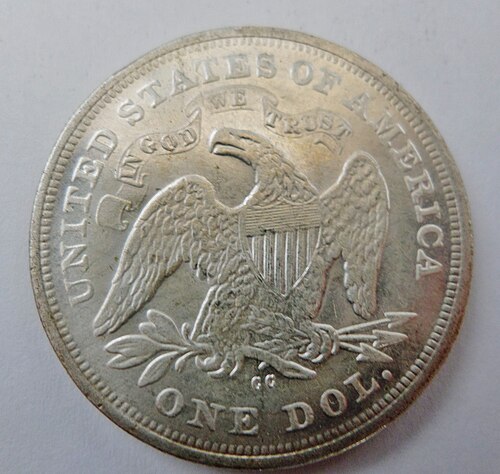
The front shows Liberty, designed by Christian Gobrecht, sitting on a rock and holding a shield and a pole with a cap on top, with stars around her. The back shows an eagle with a shield on its chest, holding arrows and an olive branch, with ONE DOL. below. From 1866 on, the motto IN GOD WE TRUST appears on a ribbon above the eagle. It is 38.1 mm across, the same size as a Morgan dollar, with a reeded edge. Most were struck in Philadelphia and have no mint mark; coins from New Orleans, San Francisco and Carson City carry a small O, S or CC. Carson City coins and a few dates are rare and worth far more. Don't confuse it with the 1873–1885 trade dollar, which also shows a seated Liberty but is a little heavier and says TRADE DOLLAR on the back.
Why does a dealer pay less than melt value?
Dealers need room to cover refining, shipping and resale costs, so most pay a percentage of melt value for common-date coins.
What is "junk silver"?
Common-date 90% silver coins that are bought and sold for their silver content rather than their collector value.
Is it legal to melt coins?
US rules (31 CFR part 82) prohibit melting one-cent and five-cent US coins. That rule does not cover dimes, quarters, half dollars, dollars or bullion coins. Most people sell coins whole to a dealer rather than melting them.